
Threads is Still a Twitter-Killer
Three Reasons Threads Will Beat Twitter[X] in the Long Run

On July 5th, Meta released Threads, its new text-based conversation app. Since then, there’s been a media rollercoaster. At first, media outlets branded Threads as the “Twitter-killer”, praising the platform for hitting 100M users in just 5 days—the fastest any app/software/technology/product in general has ever reached that mark.
However, over the past few weeks, they’ve completely backtracked, reporting that Threads has seen a “70% drop off in users” and “only has 13M daily active users”. To those same tech journalists, Threads is now pretty much dead—and Twitter [or X or whatever…] has already won.
There’s two problems with this narrative.
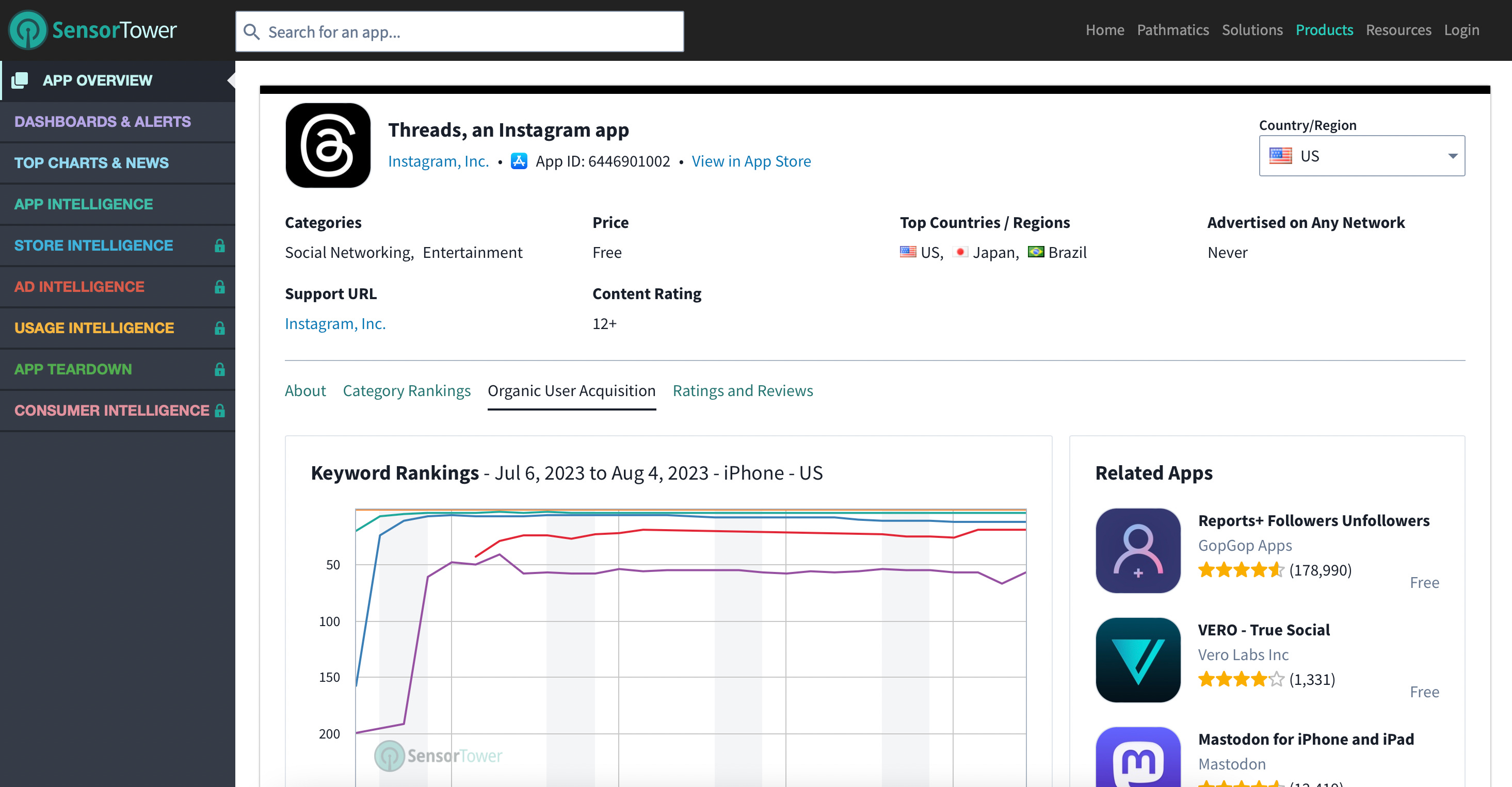
First, it’s extremely misleading. There are two reports almost every media article is linking to: Sensor Tower and SimilarWeb. If you actually take a look at them, you’ll find that they’re both egregious. Both reports only approximate the number of Threads users on Android, because it’s “somewhat easier to track than usage on iOS”. They completely ignore Apple users, and considering over 60% of Americans use iPhones, that’s a pretty big problem. Furthermore, the methodologies for both studies use vague “partner data signals” to approximate their metrics. It’s not exactly clear what that means, but I’m sure it’s not very accurate.
And for the cherry on top, here’s a screenshot of Sensor Tower’s dashboard lol:
The only way to get tangible data on Threads users is from Meta itself.
Second, and honestly more importantly, it’s been a month since Threads was released. The primary driver of churn has been a lack of features, but Meta has a robust product roadmap it’s already speeding through. For example, Threads just shipped a new “following” feature that significantly improves the user experience and is bound to increase retention. Software takes time to improve and find product market fit, so it’s important to give Threads the grace period it deserves. Ultimately, it’s extremely myopic to waive the app off as a failure this early.
Instead, there are three reasons why Threads will win in the long run: Platform, Creators, and Markets.
Platform
Threads vs Twitter[X] is really just a battle in the greater Meta vs Twitter[X] social media war. Over 60% of Instagram users also use Twitter[X], and over 85% of Twitter[X] users also use Instagram. Over 50% of Facebook users are on Twitter[X], and over 86% of Twitter[X] users are also on Facebook. Twitter and Meta are largely competing for the same intersection of users, so it’s not just app against app or business line against business line—it’s platform vs platform.
There’s three fronts to this platform war: Positioning, Engineering Levers, and Ad Revenue.
Positioning
The fundamental difference between Meta and Twitter is their competitive positioning. While Facebook and Instagram are overwhelmingly used for memes, Reels [reposted from TikTok], and entertainment, Twitter is used for news, debating the political and economic state of the world, and information. Seriously. Over 50% of Facebook users and over 60% of Instagram users say they use the respective apps for entertainment content, whereas over 33% of tweets are purely political and 66% of tweets link to news articles.
This is critical because entertainment online is a much larger market than information. Over 6 in 10 people go online to be entertained while only 3 in 10 go online to read the news. The ceiling for Meta, and by extension Threads, is significantly higher than the ceiling for Twitter—which is still struggling with profitability despite already capturing a significant chunk of its news market.
Engineering Levers
It’s reported that less than 60 employees built Threads, with some rumors claiming it was a team of only “6 elite engineers”.
Elon should be TERRIFIED.
Twitter[X]’s features are pretty much the only moat defending the business from Meta in the status quo. The faster Zuckerberg grinds through the Threads product roadmap, the more and more Meta will whittle down Twitter[X]’s competitive advantage.
For some context, while Twitter[X] only has 550 engineers [after Elon fired 80% of its staff, of course], Meta has around 30,000 [probably a bit less after recent layoffs]. Allocating just 5% of Meta’s engineers would give Threads almost triple Twitter’s headcount. And the commitment is there: according to an internal town hall, Meta is investing heavily in developing “retention-hooks” for Threads, with executives focused on driving new features to bolster retention.
Coupled with Meta’s technical infrastructure and deployment efficiency [again, only 6 engineers??], Threads has the engineering levers to ship fast and zip through the product roadmap. As a result, retention will increase and Threads’ DAUs will become much stickier—potentially even stealing users directly from Twitter[X].
Ad Revenue
This is really the elephant in the room. Ad revenue is the primary source of revenue for [most] social platforms. 90% of Twitter[X]’s revenue and almost 98% of Meta’s revenue comes from ads. It’s especially critical for Twitter[X], which was levered with over $13B of debt during the late 2022 buyout and needs the cash flow to service its interest payments.
The only problem is that advertisers kinda hate Twitter[X]. There’s a laundry list of reasons why including: the platform’s hate speech problem, Elon Musk, lack of content moderation, drop off of users, chaos and volatility, Elon Musk again, and most recently, threatening advertisers’ verified status. As a result, over half of Twitter[X]’s top 1000 advertisers have completely pulled out of the platform, and overall ads revenue has dropped by 50%.
Rather than actually responding to advertiser concerns, Twitter[X] has of course resorted to suing anti-hate speech groups for “scaring away advertisers”
On the other hand, brands love Threads. Meta’s content moderation policies have made Threads a safe-haven for social media marketing teams fleeing from Twitter[X]. Indeed, Threads has become the “new cool hangout for brands” with tons of organic growth opportunities. In fact, brands have seen 87% more engagement on Threads than Twitter[X]—despite Threads having fewer users. At the end of the day, although Meta hasn’t monetized Threads yet, advertisers are eager to start spending tons of money once the feature is released.
Furthermore, diverting advertising spend to Threads would be frictionless. Pretty much all social media teams would have to do is check off an extra box on the Meta Business Suite [Meta’s advertising platform] and automatically unlock Threads ads campaigns. This is critical because over $110B is spent on ads within the Meta ecosystem every year, and that number is projected to increase to over $120B in 2023. That’s a LOT of money.
Given these tailwinds, Threads is expected to contribute over $8B to Meta’s bottom line by 2025. Meanwhile, Twitter still hasn’t broken even.
In this platform war, revenue is the best leading indicator out there. Profitable social media platforms are able to invest in growth and scale faster, whereas platforms that lose money cut headcount, start charging for existing features, and sacrifice their user experience to stay afloat [*cough* Twitter[X]].
Creators
In a cutthroat social media market that’s driven by network effects and user engagement, the key to long term growth is unlocking the creator flywheel. There’s three parts to this flywheel: creators, content, and followers. Their relationship is simple: influencers create content, content attracts followers, and more users on a platform incentivize influencers to create more content [and so on and so forth]. The creator flywheel is a positive feedback loop that compounds on itself and supercharges growth in the long run—enabling social networks to scale exponentially.
The fuel that feeds this loop is creators. Content goes viral but eventually dies, users come but eventually go—creators are persistent. They often see social media as a means to make a living or find a purpose, meaning they’re highly attached to their platforms and fanbases. To kickstart the creator flywheel, social networks need influencers. For example, that’s why Snapchat pays influencers like David Dobrik and Katie Feeney millions of dollars a year to post on the platform.
There are two reasons threads will have more influencers and unlock a more powerful creator flywheel than Twitter[X].
First, Threads is still in its infancy, and influencers see it as the perfect opportunity to grow their audiences quickly through organic content. Conversely, Twitter[X] is a sinking ship with saturated content niches and Elon limiting the number of tweets users can see—making it difficult for creators to gain exposure. Threads inherently offers influencers much more upside, meaning it’ll likely attract more of them in the long run.
Second, Threads builds off of influencers’ existing Instagram audiences. A critical component within Meta’s initial Threads Go-To-Market strategy was using Instagram as its growth engine: creating accounts from users’ existing Instagram profiles and allowing them to transfer their entire “following” lists in one click. By doing so, Meta made it easy for influencers to retain their Instagram followers on Threads, meaning creators didn’t have to start from scratch and unlocked a powerful distribution advantage on a lucrative new platform.
In fact Threads likely already has more influencers than Twitter[X]. Here’s the math. Twitter[X] has approximately 293,000 influencers on its platform, assuming an “influencer” is an account with over 10,000 followers. On the other hand, Instagram has over 1,280,000 influencers, adopting an even more conservative definition of “influencer” as an account with over 15,000 followers. A comprehensive study found that 61% of Instagram influencers have created Threads accounts and 54% of Instagram influencers have already posted sponsored content on Threads [indicating meaningful influencer engagement]. The grand total is that there are currently over 780,000 influencer accounts on Threads with over 690,000 monetizing their Threads content. That’s a lot more than Twitter[X].
Threads will only continue to build this influencer advantage as it rolls out more and more product features, meaning its creator flywheel will only become more powerful over time. Twitter[X] can’t really say the same.
Markets
The Threads vs Twitter[X] debate has largely been focused on the American market. However, given that there are approximately 4.6B social media users worldwide and the entire United States population is only 335M, it’s clear we need to step outside of this US-centric model and examine growth in international markets.
Below is a table containing the top ten countries with the most social media users.
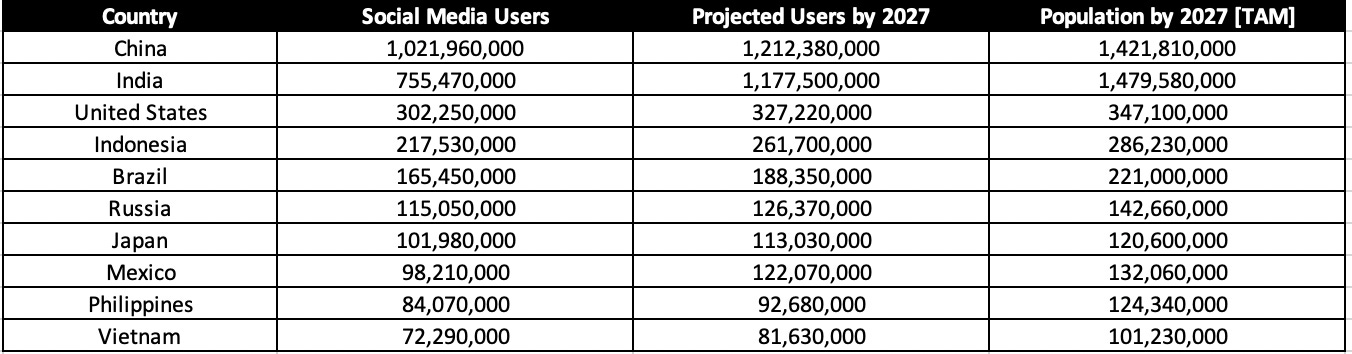
One of them stands out from the rest. India has the second most social media users in the status quo with over 750M. The only other nation it falls behind is China, which is pretty much inaccessible to Western social media platforms given the CCP’s strict internet censorship protocol. Furthermore, India is projected to have almost 1.2B people on social media by 2027, more than the next six countries combined. India is by far the largest accessible social media market in the world and it will only continue to grow in the future. Therefore, the Indian market is a critical flashpoint in the Threads-Twitter[X] conflict and could single-handedly determine the winner [regardless of who wins in other markets].
Unfortunately for Twitter[X], there are three reasons the platform is bound to fail in India.
First, Twitter[X] more or less ignores India in its long term strategy. The platform only has 15M Indian users—barely a drop in the bucket compared to the 750M Indians on social media. That’s why in November, Elon Musk fired 90% of Twitter[X] India’s staff, including 70% of its product and engineering teams [plus he took away their snacks :( ]. By gutting its regional offices, it’s clear that Twitter[X] just doesn’t prioritize India.
Second, the Indian government is cracking down on Twitter[X] and its emphasis on free speech. Twitter[X] has an extremely rocky relationship with Narendra Modi’s government. It started in early 2021 when Twitter[X] was slow to comply with a set of new content moderation policies, leading to Indian police raiding Twitter[X] offices and employee homes. Since then, co-founder Jack Dorsey claims that the government has threatened to shut down Twitter[X] India’s doors multiple times. The most recent clash was just this past month, when the platform attempted to sue the federal government for orders to take down tweets—but the lawsuit was thrown out by Indian courts. Twitter[X] is the punching bag for Modi’s free speech crackdown, surely slowing down the platform’s growth in India.
Third, the overwhelming majority of Indians see Twitter[X] as an app for news and information—not unlike any other market. However, the key difference in India is that most Indians heavily prefer using WhatsApp [also owned by Meta] as their primary social media for news updates over Twitter[X]. While Twitter[X] only has 15M Indian users, WhatsApp is by far the largest social network in India with over 480M users. WhatsApp is simply too ubiquitous in India for Twitter[X] to gain a foothold in the market as another news platform.
Overall, these three factors come together and make it extremely difficult for Twitter[X] to capitalize on the Indian market’s growth over the coming years.
On the other hand, Threads is poised to dominate the Indian social media scene. Unlike Twitter[X], Meta sees the Indian market as its prized possession. India is the number one country that Meta users are from—with almost 370M Indians on Facebook, over 325M Indians on Instagram, and over 480M Indians on WhatsApp. Given the degree of Meta’s Indian market penetration, it’s no surprise that out of the 150M Threads users worldwide, over 48M are Indian. Furthermore, despite laying off over 11,000 employees globally over the past year, Meta laid off less than 30 across its Indian offices—signaling the company’s commitment to the Indian market. Finally, unlike its Elon-run counterpart, Meta has historically complied with the Indian government’s social media policies. For example, Meta has cooperated with over 55,000 data requests from the government and even signed a memorandum of understanding with the Ministry of Electronics and Information Technology to advance AI-technologies in India.
Ultimately, Threads has the infrastructure, resources, and government support to seize the Indian social media market.
Conclusion
Although Threads was only released about a month ago, the new network is building the competitive advantages across Platform, Creators, and Markets to dethrone Twitter[X] as the world’s number one text-based social platform. Despite a short term drop off in users, Threads will continue to roll out new features, bolster retention, and scale to defeat Twitter[X] in the long run.
While there’s no way to see the future and say for certain that either Threads or Twitter[X] will win, the case is certainly stronger for Threads. Worst case scenario, we can wait and see who wins the MMA fight between Zuckerberg and Musk—although just like their social media platforms, apparently Zuck is favored to win.